logo.gif (3909 bytes)  Home Up Search Free StuffThe Great Tomaso


Movement! A kinetic sculpture exhibition

July 2011

The Clifton Cultural Art Center
3711 Clifton Avenue
Cincinnati, Ohio 45220

Artists:

Christian Benefiel (via an artist residency in Helsinki, Finland)

Billy Colbert (Washington, DC)

J. Daniel Graham (Georgetown, KY)

Joseph Hoffman (Columbus, OH)

Fred Ellenberger (Cincinnati, OH)

Tom Lohre (Cincinnati, OH)

Brad Meredith (Louisville, KY) &

internationally recognized TODT.


Man Powered Art Making Machines

The Sailing Ride, Tree limbs, Come-along, Tow straps, Plywood, 2010

Working on his art show about the sailing trip across the North Atlantic Tom felt he needed something to illustrate the occasional beating you take not only figuratively but also in reality. When the boat is beating up wind, you are slammed into the gunnels often. Broken ribs are not that uncommon. Broken relationships are not that uncommon either. The loved ones left onshore get beaten up emotionally. At first he thought he could make a “Mechanical Sailboat” like the “Mechanical Bull” you find in Texas Road Houses. His love of mobiles and thoughts of the movement you needed to simulate a sailboat lead him directly to a huge mobile suspended from a tree made of tree limbs. As the sailor-rider gets moved up and down and around by the grounds persons pulling ropes attached to the far ends of the limbs they are passed hot cups of coffee that gets spilled and occasionally a bucket of water is thrown on them. All the while they watch the video shot during the trip on a big sheet from a LCD projector. It should prove to be a fantastic event. Of course you will have to pay big bucks to ride but you will get the log book and DVD from the trip and maybe a piece of scrimshaw or oil painting of the sail.

The Artisto Family of Art Machines

Tom began thinking seriously about using robotics to make painters in 1984. He was painting in Nantucket at the time and began ordering robotics parts from various sources and assembling them into mostly automatic paint dispensing reproduce colors but now see the advantage of sporadic output that varies according to the environment. 
 
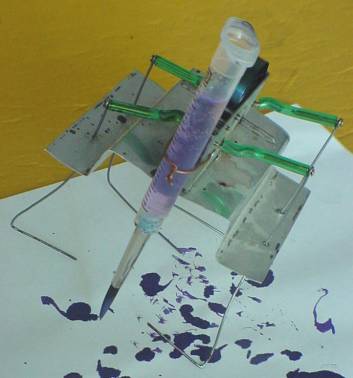
His first robot that actually painted did not come until 1999 when he adapted a windup motor he got in a mechanical junk store in China Town NYC about 7 years earlier. He always wanted to do just this with the motor but it was not until he applied for a grant that he needed a real piece of art. The little machine dragged a brush across a piece of paper slowly and with  visual pain. Occasionally it would pick the brush up and it made the most amazing abstract works. 

Windo

Windup motor, brush, syringe, wire, 5.5”H x 3.5”W x 3.5L
Windo was the first art machine to perform in public.

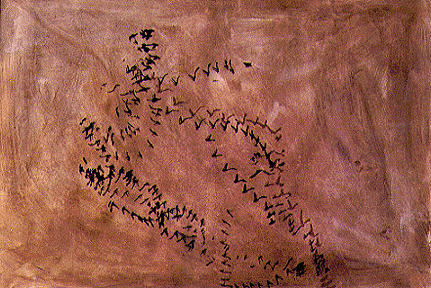
Watercolor made by a windup craw 

Flying Pigs by Windo, Watercolor on paper, 23" x 16", February 3rd, 1999
autumediasmall.wmv Watch the video of Windo, Remoto & Artisto

Spiro

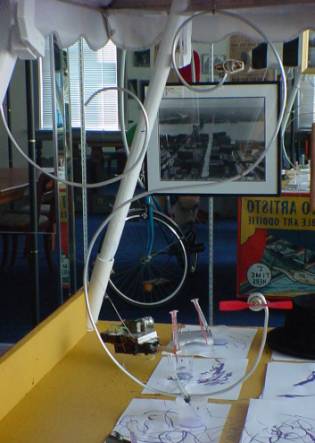
Spiro is a mobile of two parts that rotates a brush around it centerline. It is powered by a propeller and hangs from the center post of the awing.
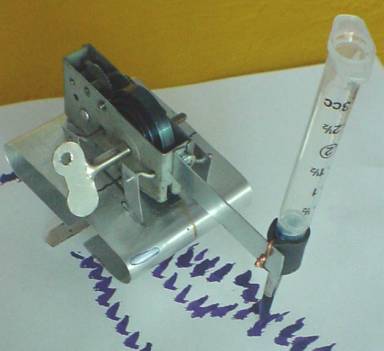
Mechino

Mechino uses a windup motor to drive four flat legs shafts propelling it forward as it paints with a self-loading brush.
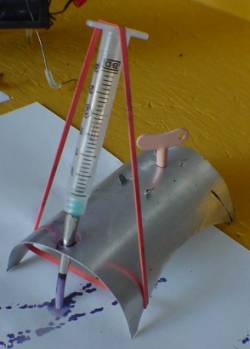
Jumpo

Jumpo uses a windup vibrator to make it jump across the paper. It paints in a pointillist manner using a self-loading brush.
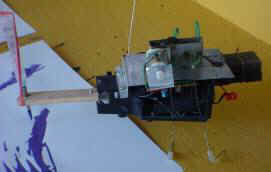
Remoto

Remote control circuits, motors, batteries, wire, brush, 12” x 6.5” x 5”

autumediasmall.wmv Watch the video of Windo, Remoto & Artisto

Tom’s second robot had to be bigger. He needed larger pieces and the little windup artist could only paint for a few inches until it needed to be wound up again. That is when he adapted a remote controlled car into another type of windup painter. This one used the drive motor to power the windup motor’s gearbox. The gearbox gave him four rotating shafts that operated the four little feet. But adjusting the length of the feet and the crank diameter the gearbox caused the robot to have a struggled walk. The new motorized version was quite a bit heavier and used an automatic loading brush. The process yielded a good operating machine along the lines of the previous windup artist.
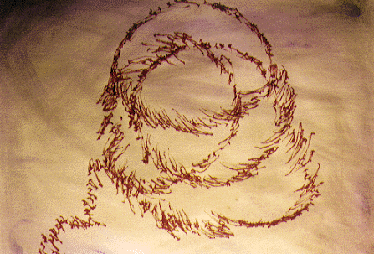
circles.gif (76098 bytes)

Painted by Remoto

This show was funded by the City of Cincinnati with a 2001 Individual Artist Grant in the amount of $3,500. Tom used the money to combine all his Art making robots into a show packaged in a Circus Side Show format.

Human Powered Art Making Machines

Tom later thought larger human powered art making machines would be more accessible to the public’s imagination so he built the sculpture making exercise bike, the flying bicycle and developed the pushcart.Now he feels that Art can be advanced with the application of Art related Science. Look for intelligent Art machines powered by vision analysis software in the near future. The first project out of the box will be a simple software program that will search the web, select images, filter them into a cohesive whole and print them out all while you are away from your computer.
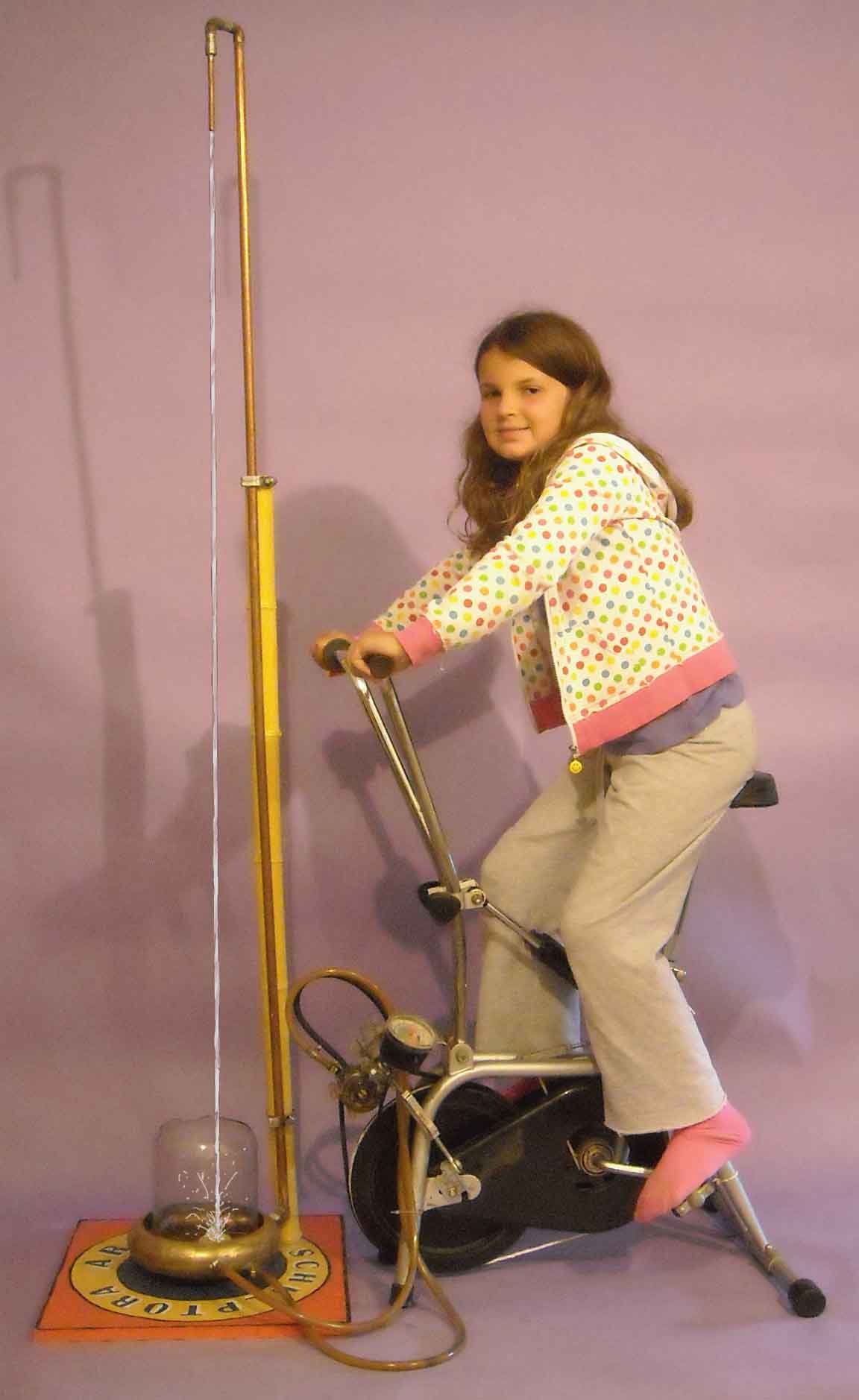
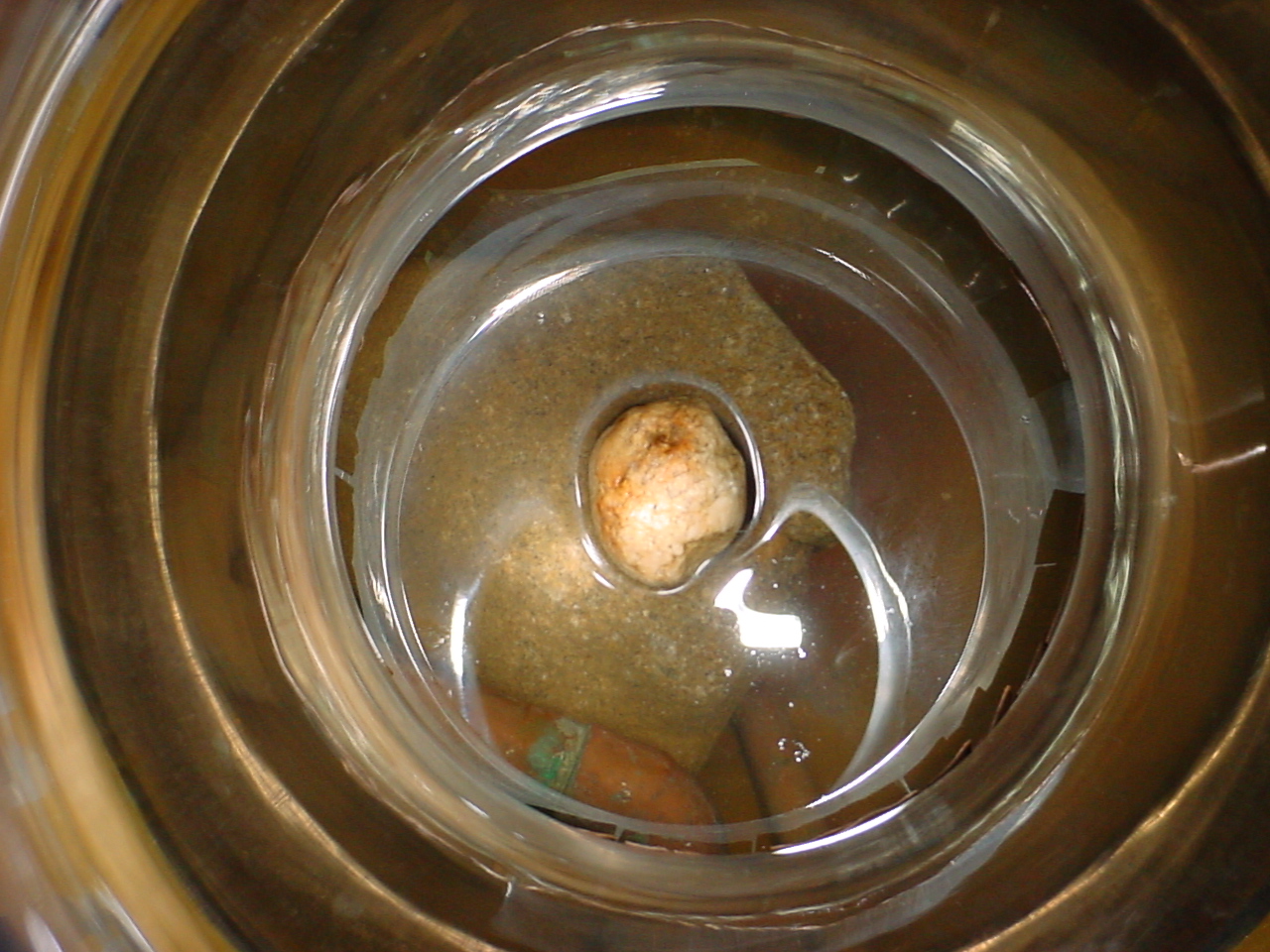
Sculptura

Schupture Making Exerize Machine by Tom Lohre

Exercise bike with flywheel, tubing, brass bowl, copper tubing, plastic tubing, water pump, hardware; 5' x 3' x 6'; July 1st, 2000 

Exercise bike with flywheel, tubing, brass bowl, copper tubing, plastic tubing, water pump and hardware

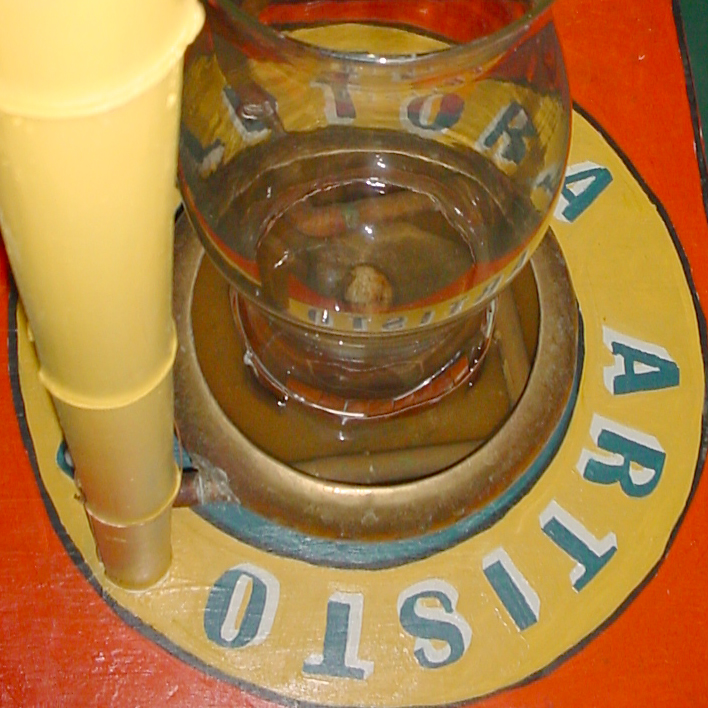
Sculptura makes rock sculpture from a human powered waterfall. It uses an exercise bike to run a water pump that forces a small stream of water straight down five feet making a small rock erode into a sphere as it turns in another rock.

The Waterfall Bicycle was created to make art while exercising. You may have heard about placing a rock under a water fall and come back and find that it had been turned into a round marble. The Art Making Exercising Machine works the same way pedaling the water pump makes the rock turn in a depression in another rock.  

TOMASO’S FLYING BICYCLE

The bicycle has it’s own colorful propeller and balloons attached to a bar that encircles the driver and passenger. As they ride, many times they leave the ground.


The Flying Bicycle 

       The bicycle has a propeller and a lot of balloons attached above it. If there were a lot of balloons the bike may float. But the better thing to remember that if the balloons will lift the bike then you better tie it down before you get off it. This means a grappling hook and rope will be attached to the bike 

The propeller is made out of stiff colorful flooring foam attached with a curve to give it enough strength to create trust but not to cut your hand when you place it in the propeller path. 

 
The mount for the propeller has is free wheeling when no trust is applied.  The hub of the propeller is the hub of a caster bike. The chain will attaches to one of the rear wheel sprockets. The bike will not be able to change rear gears. 
 
A metal bar is bent to make up the balloon holder. 

TOMASO’S SMALL ART MACHINES PERFORM ON THE TOP OF HIS PUSHCART

Art Pushcart 

The pushcart is the circus floor for the small Art Machines. The Side Show takes place on top of the pushcart.The art pushcart is made out of light materials and has an awning over the box’s top working surface. The art pushcart will roll on three  large wheels and have fourth leg thatdrops down next to the fourth small wheel, one handle at one end will help push it. The art pushcart will be made so it can roll on the sidewalks. It will be colorfully painted. 

In the spirit of the old time push carts, the pushcart was built. A colorful pushcart that can be pushed around Cincinnati neighborhoods.

A neighbor said he had a pushcart in his basement. The pushcart was the most fantastic thing Tom could imagine. It was a tilted low box with a ingenious black and white striped awning frame attached to it and the whole thing was held up by a small child’s bike on one side, a third bicycle wheel attached by twin “V” bars along with a four collapsing leg on the other side.  Tom painted Circus Side Show banners for his show to replace the vinyl sides on the original pushcart and replaced the top with a flat top

Side Banners

Conclusions

The whole aspect of these machines is to give them the power to think for themselves and do what they feel is best.  The audience wants to be entertained. The robot can only do that by producing art that is entertaining. The process of creating art is not entertainment. The first robot paintings are entertaining along the lines of Zen. The robot walks around the canvas. The stroke of the artist attacks any position of the canvas immediately. The robot should do the same. The loading of the brush is an important part of the process but is not necessary. The stroke is necessary. But entertaining the public is more important. 


Shows

HERE Gallery 1999, http://www.here.org/see/now/

HERE GALLERY
145 6TH AVE
NY NY 10009
212-647-0202
145 Sixth Ave. (between Spring and Broome)
NY, NY 10013


Tomaso Performed Incredible Art Feats

In a circus side show atmosphere the works were shown at

THE VISUAL HISTORY GALLERY

Hyde Park Square 3437 Michigan Ave.

CINCINNATI, OHIO 45208

513-871-6065 in August 2002


“Machines of Art,” in three YouTube uploads, are three videos of art making machines making art. The first is a small hand size art making machine that uses a windup motor driven four legged walking motion that drags a brush. The second art making machine is a remotely controlled four legged walking machine that paints with an arm holding a self loading brush. The last art making machine uses the Legos MindStorm Invention System to power a rotating eight color oil pastel head. It moves to a position, receives color information from a computer, applies the color and then moves to the next position. The 5000 dots take 18 hours to complete. Tom Lohre has been working since 1987 on automaton art making machines.


Show of Art Work by Tom Lohre and a Lego Robot Assistant
Opening: Friday, April 18th, 2008, 6 to 9 p.m. Closing May 18th

Visual History Gallery, 2709 Observatory Ave, Cincinnati, OH 45208,
513-871-6065, Hyde Park Neighborhood, Free, No reservation needed. Children welcomed.
Opening: Friday April 18, 2008, 6 to 9 p.m., light refreshments served.
Open: Open Tues-Thurs: 11-6, Fri: 11-5, Sat: 10-3:30, Sunday by chance or appointment. Closed Monday Web Site: http://visualhistorygallery.com

Link to the paintings in the show: http://tomlohre.com/newart.htm

Link to the brochure: http://tomlohre.com/VHG08.pdf

The Story
In 1980 Tom started exploring the possibility of having a machine paint. In 2003 he discovered Lego's MindStorm Robotic system and spent four years learning the software. On January 5th, 2007 at 9pm Tom finally cracked the code to write a program that took information from an image in the computer and fed it to a robot.

In the past year, Tom has learned that “Artisto”, the name Tom has given to the robot, is like a classical assistant. Artisto lays one of eight colors in generally the correct spot and Tom manipulates it to refine its placement. Tom initially creates an image in the computer that Artisto follows. The painting process takes 18 hours for a 16” x 20” having 4163 dots. Tom can turn “Artisto” off while working on a painting so the painting does not have to be done all at one time. All the paintings in the show are close ups of faces because the resolution is so low that he has to rely on the viewer to fill in the blanks.

In the future, Tom sees “Artisto” having 16 colors to select from with Tom working closely with Artisto continually adjusting the paint as it is laid down.

                                    Portraits of All Sorts